Category Archives: News
Avifauna studies continue in Gökova SEPA
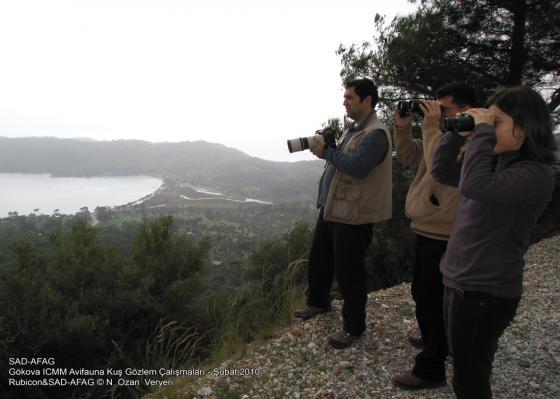
Avifauna studies are carried out at full steam in Gökova Bay within the context of SAD-AFAG Gökova ICMM Project funded by BBI Matra.
Cem Orkuna Kıraç and N. Ozan Veryeri from Underwater Research Society, Kasım Kırlangıç from METU Bird Watching Group and Ayşegül Dursun from Hacettepe Bird Watching Group carried out the avifauna studies between 13 and 18 February 2010 Along the coasts and coastal wetlands within Gökova SEPA Region and performed the monitoring and reporting activities. Also in April, three-day field study performed between the dates of 16-17-18 April 2010 to explore breeding birds of the region in addition.
Both spot observations from the stations and transect observations by following a certain line were carried out in the bird-watching studies representing entire coast line of the Gökova SEPA Region. All birds observed during the studies identified visually with the help of binoculars and recorded by telephoto lens. Within the bird-watching studies conducted, some species were observed and photographed for the first time along the Gökova Bay such as highly-likely breeding a couple of Osprey (Pandion haliaetus) , Caspian Tern (Sterna Caspian), Rüppell’s Warbler (Sylvia rueppelli) and Bonelli’s Eagle (Hieraaetus fasciatus). So far a total of 90 species of birds were defined in field studies. According the data obtained from the prior field studies in the region, approximately 150 bird species have been found to be living in the beach, sea and islands of Gökova. The most important bird habitats in the region are the plains in the eastern edge of Gökova Gulf mainly comprise of sand dunes and wetlands, especially artificial breakwater and coastal line in Çalca Hill (a pair of osprey is seen while feeding on the area), all river branches and their estuaries, pristine and uninhabited rocky coastal areas sheltering common shags.
Studies are held in different habitats and at least in 20 different locations to cover entire Gökova Special Environmental Protected Area. The entire project area is divided standard 1×1 km grids by the project GIS expert. Observations in each fieldwork were entered in the database as separate data together with the codes of 1 km2 scaled grids. Thus it’s possible to perform comprehensive analysis according to time, space and species. As for this will serve as an important scientific base for the planners in order to protect natural values and keep them for the future generations and planning integrated coastal and marine areas in Gökova. As a result of the studies driven, effects of human activities on bird breeding areas and birds will be quantitatively and spatially understood.
Unsolved Seal Murder in Bodrum Yalıkavak
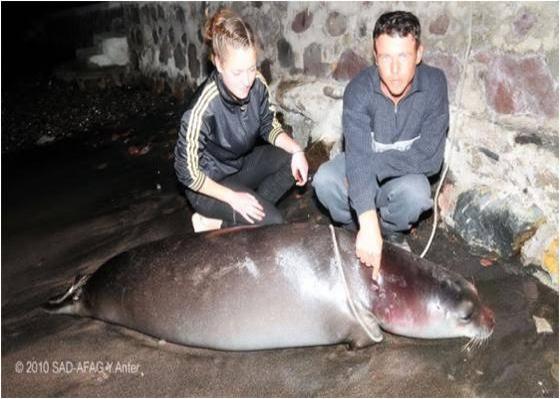
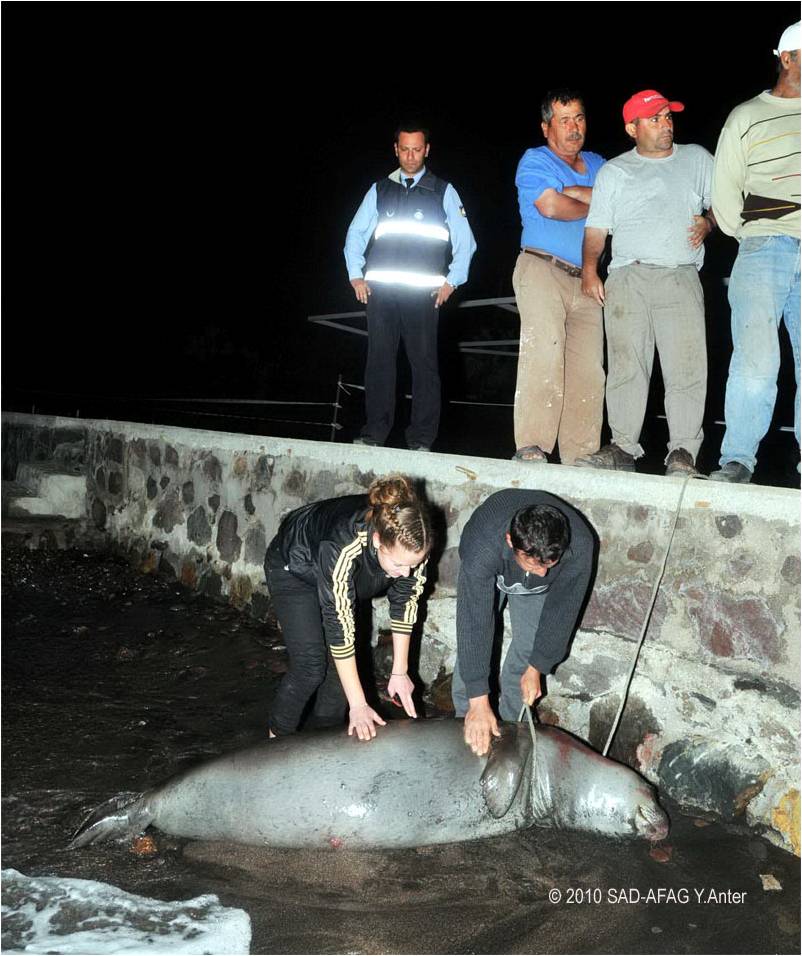
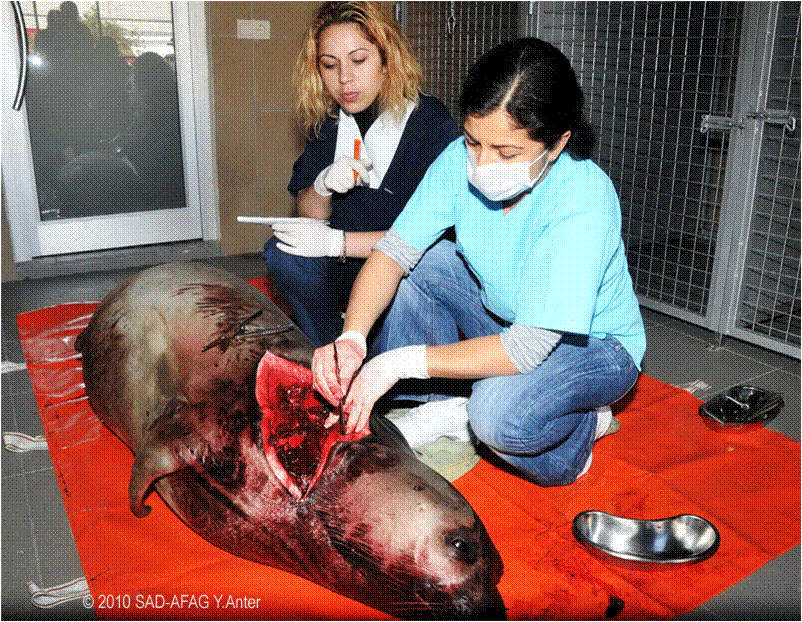
Muammer Aşan, the director of Sporkent 1 Building Complex and Üstün Mavi, care-taker of the site saw a corpse on the sea in the Yalıkavak Kızılburun region, coast of in Bodrum Peninsula on the date of April 21, 2010 while walking around the site and realized it belongs to a Mediterranean Monk Seal and pulled the corpse with own means to the beach. They called immediately Yalıkavak Municipality and SAD-AFAG representative veterinarian Fulya Massozi. Fulya Massozi contacted with SAD-AFAG AFBIKA team and she arrived in the area around 19:00 PM with the corporation of Yalıkavak Municipality and performed first examination on the death seal together with municipality constabulary officers in the beach. Afterwards seal corpse carried to Yalıkavak center with municipality vehicle to make further examinations.
In consequence of the necropsy performed in veterinary clinic in Yalıkavak, it’s determined that seal is shot by three firearms in the right shoulder, multiple ribs and it right shoulder bone are broken, large blood accumulation occurs in chest cavity and internal bleeding cause the death. One rifle bullet and many small sized pellets found in the inner parts of the seal in the detailed examinations within necropsy. In other words, it’s understood that seal was shot several times before it’s found, probably in different places, and shot by small pellets apart from the shot (rifle bullet) cause the death of seal.
Mediterranean monk seal shot intentionally in the sea- likely from a boat- was a pubescent (the period before becoming an adult) member and had around 150 kg weight. Fulya Massozi, Yalıkavak representative of SAD-AFAG, indicate that the seal was a very healthy member of its kind and doesn’t found any other diseases.
According to the national legislation, Mediterranean monk seals are among strictly protected species and shooting has 10.000 TL fine. However SAD-AFAG, carrying non-stop studies on Mediterranean monk seals and their habitats since 1987, hasn’t witnessed any incidents that Mediterranean monk seal murderers are caught or anybody punished for these actions in Turkey. Although Mediterranean monk seals are under protection with Bern and Barcelona Conventions concerning also Turkey as a party with all protocols, any effective precautions couldn’t been taken against the intentional murdering incidents. The ideal solution to reduce such deliberate killings is to develop sustainable fishery policies based on scientific studies, assure implementation and control of illegal trawl, purse-seiners, spear fishing, dynamite fishing and basket fishing instead of making searches for the shooters. Deliberate killing of seals will be decreased in case of rivalry among the coastal fishermen and monk seal as a result of the increase in fish stocks in the seas.
The primary reason causing extinction of Mediterranean monk seal is actually coastal development. Concreted coasts and coastal roads are primary elements that prevent breeding of monk seals by destroying their homes, natural coastal habitats. These rare marine mammals living dependently on the coasts- resting, breeding and raising and feedings its puppies in the caves, certainly need scarce and intact coasts and coastal caves. Ministry of Environment and Forestry, Environmental Protection Agency for Special Areas, Ministry of Public Works, Ministry of Culture and Tourism and Municipalities have to consider this factor carrying coastal plans and constructional works. Additionally it’s definite that coastal constructions and new road opening works are undeniable causes of irreversible coastal losses and natural area destructions. SAD-AFAG and National Monk Seal Comity is ready to provide most actual and accurate data to planners in case of consultancy is required about coastal development planning including new road planning.
© 2010 SAD-AFAG C.O.Kıraç
The questionnaries completed in Gökova

As part of the “Gökova Integrated Coastal and Marine Management Project” executed by SAD- AFAG and RUBICON Foundation with the co-operation of EPASA and MARA, the questionnaire work has been held to local main stakeholders between 21th and 24th March by SAD-AFAG team comrising N.Ozan Veryeri, Semiha Demirbaş, Denizcan Durgun, Ayhan Tonguç and Mustafa Ateş.
The questions of survey were prepared by N. Ozan Veryeri, Assist. Prof. Vahdet Ünal, Bahar Suseven, Ayhan Toprak, Gökhan Kaboğlu, Semiha Demirbaş and Cem O. Kıraç. The target occupational groups are fishermen, tourism employees, excursion boat tours, yatchers and farmers.The survey were applied totally 116 losal participant with those details; Tourism(38), Boat tours(15), Fishermen(28) and Farmer(35), mainly in Akyaka, Gökova and also Gökçe, Turnalı, Akbük, Çamlı, Akçapınar, Bucak, Okulyanı, Ovacık and Karaca settlements. The sectoral state and problems of fishery, the relation between nature conservation and EPASA, the fishing species amount and declining fish species which have high economic values were determined with the previous questionnarie work that has been done under the title of “fishery management”with all of the coastal fishermen(100 fishermen from 3 fishery cooperatives). Within this survey fishermen reply some other questions. Yatchers are the only stakeholder group that can not be reached within this field study since they are not available in the region in this season. The survey related to the yatchers will be held in the summer period. And the questionnarie will be risen up to 150 in number.
The aims of the survey are to categorise the problems of stakeholders, to determine the capacity and density of the services, to describe the relation of EPASA, how they percieve natural processes and which facility creates risk accoring to their view and to collect their previsions for development. Gökova Integrated Marine and Coastal Zone Management Project will improve with these infomations.
The areas of the services were pointed in the map by all of the participants to deteremine the land use density and distribution. This data will be located in GIS and used in analysis with other associated data. The survey questions which examine the perception, relation and proposal of the individual, are unstructured questions why the individuals are kindly asked their opinions.
We thank to all of the participants for taking their time and Bahar Suseven and GAS-Der for their contributions to designing and implementing the questionnaries.


Assessment of Karaburun Passenger Port Construction
Underwater Research Society – Mediterranean Monk Seal Group (SAD-AFAG) is assigned on the date of October 15th 2009 by the Ministry of Environment and Forestry to give opinion about possible environmental effects of the port construction project which will be executed by DLH İzmir Transportation Regional Directorate in Karaburun Arslan Cape, Mimoza Bay.
SAD-AFAG is improving its knowledge and experiences on “Coastal and Marine Areas Management and Planning” and increasing its capacity as being an organization executing international projects in corporation with scientists and related Ministries in this context. Karaburun Peninsula is highly recognized by SAD-AFAG whereby ongoing monitoring and research studies carrying on about Mediterranean Monk Seal and coastal and marine areas since 1991. Additionally scientific experts of the group took active role on the field studies and documentation works in “Mediterranean Monk Seal Monitoring and Conservation in Karaburun Peninsula Project” in the final half of 2009. In consideration of these actual and distinctive background information, the group considered to bring its opinions about environmental effects of the port together with possible socio-cultural, economic effects and coastal-marine security to the attention of the authorities and evaluated its convenience under the date of November 3th 2009.
The port project to be constructed in Arslanburnu will be comprised of 220 m. long dock, 80 m. long – 10 m. width landing-stage and 51 m. long additional dock. Two 20 m. long slopes will be constructed on the edges of the adjacent dock to ensure passengers and vehicles evacuation from ships. Landing-stage will be formed by bored pile system and back stage and dock will be constructed by sealant and side-piles. Ships with the capacity of 20 vehicles and 250 passengers will cruise on the route between İzmir Konak – Foça – Mordoğan – Karaburun. Dredging won’t be performed due to the convenience of the ground for the construction and don’t hold any characteristics of liquidization. Land filling area will be approximately 9. 500 m2 and water depth is around 0-6 meters in the area. It’s seen that 5 meters fill height will be enough as result of addition average 3 meters water depth and +2 meters dock height above sea level. According these values, it’s calculated that 47.500 m3 coastal fill will be done at the end of the project.
Our conviction on the advantages to be gained in context of the development of Karaburun by means of the investments oriented to seafaring are indicated clearly in the report and brought to the attention of official authorities. In case of the port construction come to realize, the species under protection with national and international regulations under negative interaction with the port and the species classified as endangered species according to IUCN citerias such as Mediterranean Monk Seal (Monachus monachus) and Sea grasses (Posidonia oceanica) will come into prominence. Claimed interactions, solid proofs and references are brought to the attention of official authorities as well.
The restoration and structural revision of Saipaltı Port pointed out within the report to solidify our organizational goodwill and fair positive view on seafaring in this context. It’s determined that this alternative solution will have fewer effects on the Mediterranean Monk Seals and Sea grasses and will have social and economic contributions to the region as well. The efforts and actions are continuing toward the construction of the port in Arslan Cape in contrast to its conserved environment and despite all of the scientific data and alternative solutions suggested. Additionally some unconfirmed information received about the efforts to acquit port from the context of EIA (Environmental Impact Assessment).
We have an intent motivation in monitoring this process with deep concern and take legal actions if it’s required. We observe the plastic deformation of the clean and pristine costs as a disaster as a result of wrong planning decisions and finally eliminate main reasons of the people to visit these exceptional costs such as Karaburun. We believe that the restoration of Saipaltı Port with fewer costs and fewer natural destruction will create homogeneity in the development of local economy and will highly match up with the principle of mindfully consumption of the national resources. SAD-AFAG is currently completing its preliminary studies to apply to court in case construction preparation starts .
You may contact with SAD in order to get further information on the issue.

Animation of the port planning to be constructed on Arslan Cape. (Drawn as an outline, not a technical drawing)

Healthy posidonia grasses (Posidonia oceanica) in and around Arslan Cape in Karaburun.

The coastline and beach in Karaburun Mimoza Bay, which is currently open to the public use.
Karaburun Peninsula Mediterranean Monk Seal Monitoring and Protection Project Completed
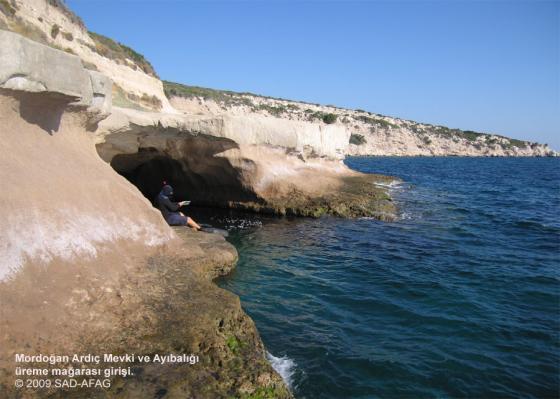
Karaburun Peninsula Mediterranean Monk Seal (Monachus monachus) Monitoring and Protection Project, contracted by Ministry of Environment and Forestry İzmir Provincial Environment and Forestry Directorate, completed under expertise of SAD-AFAG.
Issues are categorized in the aspects of human activities threatening coastal and marine areas, fishery, environmental pollution, tourism, coastal construction, human entrances to Mediterranean Monk Seal caves in Karaburun Peninsula which is one of the least degenerated coastal areas in Aegean Region and these problems are studied in detail.
SAD-AFAG took place in the project with 8 people and acquired data provided by up-to-date and distinctive field studies and intelligence studies by this team. Observed changes in Karaburun are compared with the data acquired in 1991. It’s identified and documented in the conducted studies that approximately five Mediterranean Monk Seal currently using area and this number can increase to seven.
The leading factor threatening area is defined as unplanned and dense urbanization (cooperatives) destructing characteristic coastal structure within Mordoğan and Karaburun municipality boundaries. Outlawed summer house constructions within first degree protected area in Hamzabükü, outlawed individual construction (summer houses) examples in the west side of the peninsula and dense and adjacent urbanization which is causing breakages in pristine coasts, destructing cultivated areas and violating geographical natural beauty are determined. Additionally excessive and illegal fishery examples are determined throughout the peninsula and it can also be summarized as one of the main problems threatening the area. Examples such as fishing with fish spear at night, fishing with diving tube and fishing spear, illegal troll and coastal dragging, amateur fishermen using professional techniques are also seen within the area.
The coastal zones of the peninsula is protecting under “protected area” statue. However summer house cooperatives beginning from the end point of first degree protected areas designating possible irreversible change for the area. For the purpose of olive cultivation, dense agricultural activities converting peninsula’s characteristic flora, ecology and cultural values are also appointed.
Karaburun Peninsula’s pristine coasts and habitats (caves) sheltering Mediterranean Monk Seal keep have essential importance for the nourishment, sheltering and breeding of this specie. The need of the integrated marine and coastal areas management model is evaluated for the purpose of determining utilization-protection balance of this longest natural coastal area of the Aegean Region within this project.